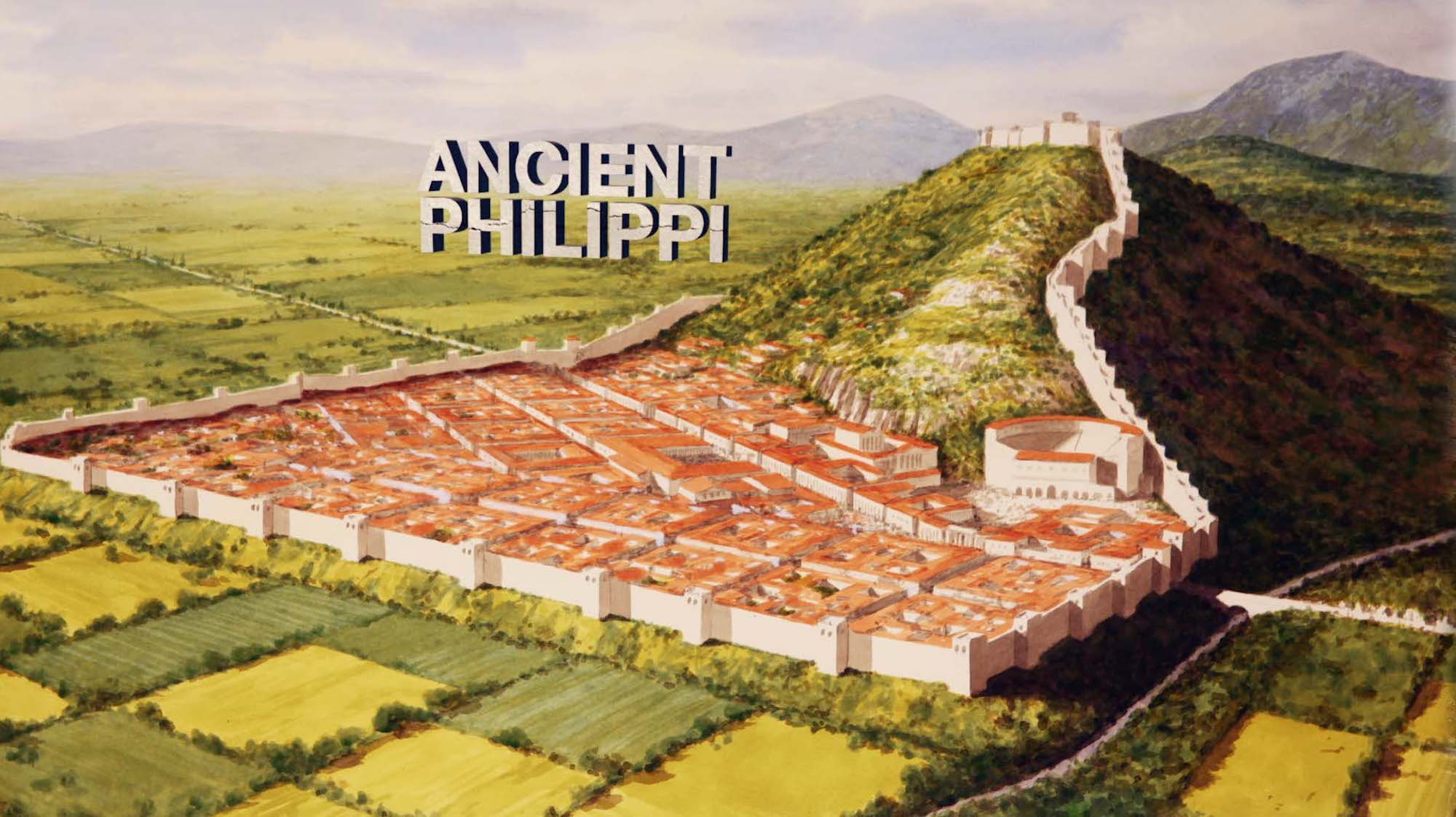
The city of Philippi in Macedonia was founded as Crenides by settlers from Thasos in about 360 BC, but only a few years after, Philip II of Macedonia conquered the city in about 356 BC and renamed it Philippi in honor of himself. The city was along the Via Egnatia, had its port at nearby Neapolis, many productive agricultural fields, and gold and gem mines were in the area, meaning that it was a strategic and wealthy city with access to many parts of the Roman Empire (Strabo, Geography; Pliny, Natural History). After the Battle of Philippi in 42 BC, which was instrumental in the downfall of the Republic and establishment of the Empire, Octavian (Augustus) founded the Roman “colony” of Philippi, where he settled former soldiers (Suetonius, Augustus). This battle occurred outside the city, to the west, with the forces of Octavian and Antony attacking the forces of Brutus and Cassius from the east, approaching the town. After the battle and establishment of the colony, the city still had its walls (2 miles in circumference) originally built by Philip of Macedon, and a theater from the Hellenistic period, which was expanded by the Romans in the 2nd century AD. Philippi is mentioned by several Roman period authors, but the majority of the information is in relation to the civil war or its conquest by Philip. Luke specified that Philippi had “colony” status, and although many cities that Paul visited on his journeys were colonies, for some reason that fact is only noted for Philippi (Acts 16:12). Luke also described it as a city of the first (of the four) district of Macedonia, which is a fourfold division known from many ancient sources about Roman Macedonia and the location of Philippi (Acts 16:12; Hemer, The Book of Acts). Other major features of the city in the 1st century included the Roman forum and the bema/judgement seat (between two fountains), the agora/marketplace (a section of the forum), baths, houses, workshops, the Via Egnatia highway, the eastern Neapolis Gate, western Krenides Gate, the decumanus maximum, an acropolis (tower on acropolis is 6th century AD though), a palaestra (like a mini-gymnasium, covered now by Basilica B), a hero cult monument dedicated to the founder of the city, a temple to the Emperor (northeast corner of forum), a Serapeum (temple to Egyptian/Hellenistic gods, particularly Serapis), the Heroon (shrine) of Philip II, monumental statues of deified Julius and Augustus Caesar (see coin of Claudius), probably a temple to Apollo and Artemis/Diana (at the acropolis), an aqueduct, and many monumental Latin inscriptions (about 85% are Latin) as a result of its Roman colony status. This city, occupying about 167 acres/68 hectares, probably had a population of at least 15,000 people. Inscriptions with the name of the city from the Roman period are visible on the library and eastern temple.
In about 49 AD, after Paul and Silas had arrived in Philippi from Neapolis, they went down to the river (probably just outside the eastern gate of the city at the nearby stream near the ancient church, or alternatively outside the western gate at the Krenides river/stream, but unlikely to be the farther site about 1.5 miles west of the city at the Gangites river) on the Sabbath and found a group of people assembled for prayer. Excavations discovered a burial inscription from the 2nd century AD that mentioned a synagogue in Philippi, but apparently there was no synagogue at Philippi during the 1st century, and the community of Jews may have been extremely small (Bakirtzis and Koester, Philippi). The Mishnah recommended that Jews live where the Torah was studied and at least 10 households were established, suggesting that the population of Jews in Philippi may have been too small to support an actual synagogue (Mishnah, Sayings of the Fathers and Sanhedrin). Therefore, the most logical place to find worshippers of God was in an assembly next to flowing water, which was related to the purity laws and the norm for communities lacking a synagogue (Philo, Flaccus). There, Paul, Silas, and Luke met Lydia, a woman from the city of Thyatira in Asia Province who had relocated to Philippi where she had a business dyeing and selling purple fabrics (Acts 16:14). The dyeing of fabrics with a red-purple dye made from the madder root was a major part of the economy in the area of Thyatira, and bringing this industry to Macedonia was probably a lucrative business decision. Although in previous centuries a relocation from Asia minor to Macedonia would have been extremely difficult, the new Empire allowed freedom of movement and excellent opportunities for commerce. Evidence for a relocation from Thyatira and starting a purple dye business, like Lydia, was discovered on a Roman period inscription in Philippi that translates “the city honored from among the purple dyers, an outstanding citizen, Antiochus the son of Lykus, a native of Thyatira…” (CIL 3.664.1; cf. also 2nd century AD Thessaloniki stele of Thyatira purple dealer in Macedonia). Although we do not know if this Antiochus had any relation or business association with Lydia, it does demonstrate the accuracy of the historical setting of the Acts narrative in Philippi. It was uncommon, but not rare, for women to own and run businesses in the Roman Empire, and evidence of a woman owner of a purple dye business is even found on an inscription (Keener, Acts; CIG 2519). However, it is also possible that Lydia co-owned the business with her husband, who is alluded to but not specifically named in the Acts narrative. It is speculative, but within the realm of possibility that the Antiochus mentioned in the inscription was the husband of Lydia. The message of Jesus Christ taught at the prayer meeting was accepted by Lydia, who is described as a worshipper of God or God fearer, and Lydia and her household became believers and were baptized (Acts 16:14-15). The name “Lydia” is absent from the epistle to the Philippians, which led a few scholars to theorize the possibility that Lydia, from Thyatira in the Lydia region, was merely a designation for a Lydian woman rather than her actual name (Ramsay, St. Paul the Traveller). It was suggested that her actual name may have been Eudoia or Syntyche, but this seems unlikely due to the widespread use of personal names in Luke-Acts rather than regional “nicknames” (Philippians 4:2). The Byzantine period Basilica of Paul (Octagonal Church, not Basilica A/B/C), identified by a mosaic inscription on the pavement and dated to 343 AD or earlier, may have been to mark the location of the riverside prayer meeting, or the church that originally met in the house of Lydia (Porphyrios; Acts 16:40).
After presenting the Gospel to people in Philippi, Paul and Silas faced opposition from a demon through the “Philippian slave girl” who had a “spirit of divination” or python spirit which was attempting to bring unwanted attention and problems to the Christians as they preached and taught (Acts 16:16-18). In ancient Greek mythology, Python or Phython was a pagan snake/dragon god who guarded the “navel of the world” at Delphi to the south, but Apollo defeated him and took over the area (Ovid, Metamorphoses). Delphi was a center for the oracle in the temple of Apollo, and the priestess was called a “Pythia,” so the term python had come to be used of the persons through whom a spirit of divination or soothsaying spoke. At Delphi, the priest interpreter would listen to the toxic fume induced babble of the Pythia High Priestess and make up an oracle out of it (Plutarch; Valerius Maximus). In the pagan Hellenistic culture, “diviners” or soothsayers were quite common, and even closer to Philippi than Delphi there was a lesser oracle of Dionysus at nearby Mount Pangaeus (Herodotus). The people of Philippi associated the idea of Python (a god) and the oracles with her, and her fortune telling had been bringing her masters great financial gain according to Luke and comparisons to known fees for oracles in ancient Greece. The setup and process at Delphi and Pangaeus were different than the fortune telling seer slave-girl in Philippi, but both were related to demonic activity. Throughout Acts, magic and demonic activity are shown as something in opposition to the Gospel, but conquered time after time by the power of the one true God (cf. Simon the Magician in Acts 8, Bar-Jesus in Acts 13, the magic spells in Ephesus in Acts 19, etc.). After many days of her annoying shouting and following, Paul finally cast out the demon in the name of Jesus Christ, but this angered her masters who had just lost their money making “fortune teller,” for which they accused Paul and Silas of unlawful activity, leading to a public beating and imprisonment (Acts 16:18-21).
The forum, measuring 230 by 485 feet, was probably the location in Philippi where Paul and Silas were dragged before the Roman praetors (2 duumviri specifically, according to information from inscriptions at Philippi), and then illegally beaten (Acts 16:19-22; 1 Thessalonians 2:2; 2 Corinthians 11:25; Suetonius, Titus). On the northern end of the forum was the bema/judgement seat, which was the likely place that the Roman officials stood or sat as they listened to the accusations and then ordered Paul and Silas to be beaten with rods (carried out by lictors, probably 6 of them). These city magistrates held the position of duumvir, according to inscriptions found at Philippi, with the Latin title translated into the typical Greek usage by Luke (Acts 16:20, 22, 38; strategos translated from “duumvir” or the title “praetor”; Hemer, The Book of Acts; Keener, Acts). The two were then briefly put in prison, secured in stocks in the dark and poorly ventilated inner prison, which would normally have been reserved for the most serious crimes. Although there is a traditional location of the “prison,” this site was a Roman period water cistern rather than a prison house with foundations and doors as described in Acts, and there is little evidence for it beyond a 5th century tradition (Acts 16:23-26; McRay, Archaeology and the New Testament). Roman prisons were usually built near the forum of a city, so it was probably nearby, but the exact location of this prison is still a mystery (Vitruvius, On Architecture). Then, a great miracle happened that night when an earthquake shook the prison, the bonds were unfastened, and the doors opened. The jailer, being responsible for guarding the prisoners, thought that he had failed in his duty and was about to commit suicide rather than face the dishonor and execution that would come as a result of his prisoners escaping (Petronius, Satyricon; Livy; Urbe Condita; cf. Acts 12:19). Fortunately, Paul prevented this fatal mistake by notifying the jailer that all prisoners were present. Then, the jailer asked the important question “what must I do to be saved?” Paul and Silas answered “Believe in the Lord Jesus Christ, and you will be saved” (Acts 16:30-31).
The earthquake may have been viewed as Divine retribution, or perhaps the magistrates thought the beating and night in jail was enough, or Lydia and others may have made a formal complaint. Nevertheless, the next day, the magistrates told the jailer that the two men could be released. However, Roman law had not been observed. Paul and Silas had been beaten with rods and thrown in jail without a trial, and Paul notified the authorities of their unlawful activities toward them as Roman citizens, which held great benefits and privileges in the Empire (16:37-39). Further, abuse of Roman citizens by the authorities could result in their expulsion from office and disqualification from ever serving again (Cicero, Against Verres). In some cases, extreme mistreatment of Roman citizens could carry harsh punishments for officials (Livy, History of Rome). Over the years, Paul often benefited from the great privileges of Roman citizenship, but he knew that heavenly citizenship was the most important. The Roman citizenship status of the residents of Philippi seems to have been an important issue, as it is not only emphasized in the narrative of Acts, but in theological illustrations used by Paul in the letter to the Philippians, where Paul points out how they must recognize that their true citizenship is in heaven (Philippians 1:27, 3:20; “to be a citizen” used in both verses). Paul also used the metaphor of “soldiers” in the army of God in this letter, which would have resonated with many of the citizens of Philippi who were former soldiers in the army of Rome (Philippians 2:25). Philippians, known as one of the “prison epistles” of Paul, was written while he was under house arrest in Rome around 61-62 AD, awaiting trial before the Emperor Nero (Philippians 1:13, 4:22). In this epistle, Paul mentions a Clement, who may have been the later bishop of Rome known from church history and his own letters (Philippians 4:3). The ministry of Paul in Rome, even while imprisoned, was so effective that many of the people in the service of the Emperor became Christians (“Praetorian guard”; “brethren in the household of Caesar”). According to coins found at Philippi, some former members of the famous Praetorian Guard had settled in the colony around the time of Paul, so the people would have been familiar with the Praetorians and may have even known some of those still in the service of the Emperor (Franz, “Gods, Gold, and the Glory of Philippi”). Epaphroditus, who is mentioned twice in the letter, was probably a leader in the Philippian church, as well as a friend of Paul who was described as a “fellow soldier,” and the deliverer of the epistle (Philippians 2:25, 4:18). Several years later, when he was back in Macedonia, Paul may have written to Timothy in Ephesus while Paul was briefly in Philippi (1 Timothy 1:3; Acts 20:1-6).
Begged to leave the city by the magistrates, lest more problems arise, Paul and Silas made a stop at the home of Lydia to greet the other Christians, then took the Via Egnatia westward, passing through an arch on the road just east of the Gangites river. Paul and Silas then went on to Thessaloniki by way of Amphipolis and Apollonia (Acts 17:1). However, Paul returned to Philippi at least once more and later wrote a letter to the church there, which consisted of a group of Christians very dear to him (Acts 20:6; cf. 1 Corinthians 16:5-6 and 2 Corinthians 2:13; Philippians). During the Byzantine period, several attacks on the city by numerous foes, plus a massive earthquake in about 620, weakened Philippi, which later became merely an outpost and then was eventually abandoned around the 14th century.
A few scholars have suggested that based on Church history, ancient manuscript additions, and the New Testament, that Luke the physician was from Antioch but had some connection with Philippi, perhaps functioning as a leader of the church there for some time (Anti-Marcionite Prologue; Eusebius, Ecclesiastical History; Jerome, Lives; Codex Bezae; references to Antioch in Acts; e.g. “Luke, who was by race an Antiochian and a physician by profession, was long a companion of Paul, and had careful conversation with the other Apostles, and in two books left us examples of the medicine for the souls which he had gained from them” -Eusebius). The first “we” passage occurs at Troas, just before the group takes the short journey to Philippi by way of Neapolis in 49 AD, but Luke stays in Macedonia rather than going on to Berea and Athens, then later in about 58 AD the narrative specifies that Luke rejoined them by sailing from Philippi (Acts 16:9-11, 17:1, 20:6). After the death of Paul, it seems that Luke returned to Macedonia and Achaia, but eventually died in Boeotia, which is a region in between the Philippi/Thessaloniki and Athens/Corinth areas, part of which belonged to the Province of Macedonia, at the age of 84 (Anti-Marcionite Prologue).
Leave a Reply